Prototype · May 2026
Walrus Ocean Loop
A two-day underwater game experiment: five recurring agent passes, daily playtesting, and small tickets for the things that broke.
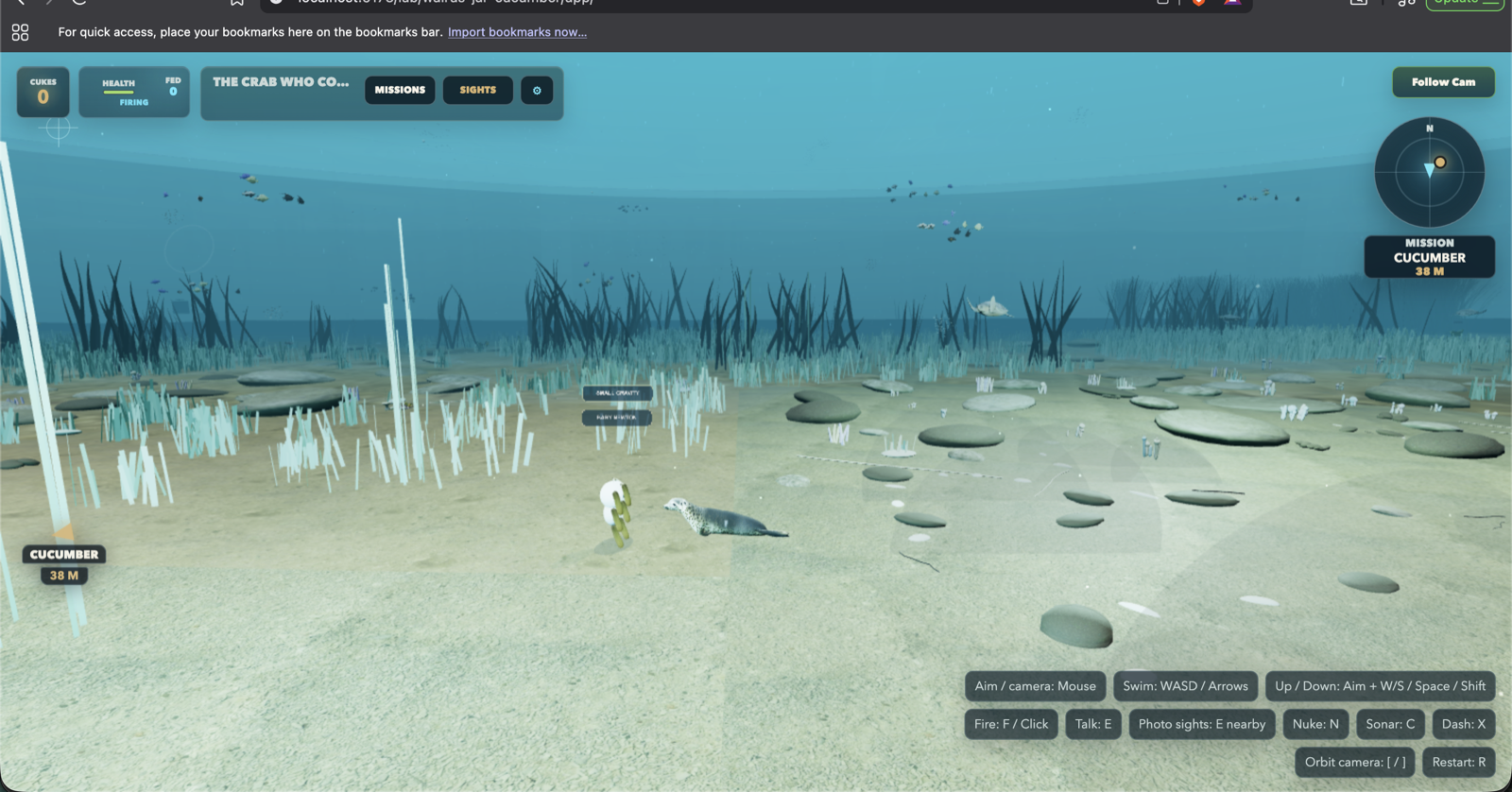
A rough underwater game built over two days to test how much an AI coding agent could improve a Three.js prototype with regular feedback.
The first prompt produced a poor result. I added the available GLB models after the agent asked for missing assets, then ran repeated passes on visuals, the underwater world, missions, controls, and code cleanup. I played the build once a day and turned the problems I found into small tickets.
I spent roughly one to two hours on it directly. By the end, the world was larger and had more creatures, assets, and missions. The implementation was still uneven.
What I gave the agent
- A shared design spec and a list of available assets.
- Five recurring passes with a separate focus for each.
- Screenshots and daily playtesting notes.
- Small tickets to work through one at a time.
The five passes
The loop had five recurring passes:
- Improve the visual aesthetic.
- Make the underwater world feel more alive.
- Expand missions, mechanics, and progression.
- Improve gameplay feel, controls, and UX.
- Review code quality and scalability.
After playtesting, I split issues into tickets and fed them back into the loop.
What came out of it
The playable build is linked above. It has more going on than the first version: a larger underwater world, more visible life, and more missions and mechanics. It still feels like a prototype.
For this experiment, the specific tickets and playtesting notes were more useful than the initial broad prompt. I could point to a problem, give it a bounded change, and play the next build to see whether it helped.